

Editorial
No shelf space for reading
by Yzabelle Dela Calzada, Rayne Gampay, Gabrielle Uy
Between the shelves kept in every bookstore is a quiet pile of dust as people continue to blur the lines of its promised purpose: reading.
Reading physical books slows us down from the ever-changing world. With reading, it takes you on a journey with every page you flip, every annotation you make, and every dog-eared page, leaving marks from where you left off. It demands a distinct kind of attention, requiring you to fully immerse yourself in something you do not get from reading digitally. It allows you to take your time digesting and living the experiences of the characters in each chapter. You stay through the joy, the heartbreak and the rage of each chapter your finger lingers in.
Books come in different lengths; they were never meant to be finished in just seconds. Books can go from 100 to even 500 pages, solidifying it as a medium readers can enjoy at their own pace. Its tangible existence already refutes how the digital world functions as something to be consumed rapidly.
This is where the problem lies.
When people treat reading as something that should be done in a flash, the enjoyment they could have experienced from physical reading is stripped away. Even if you are able to finish many books in an hour, it was never really about that in the first place.
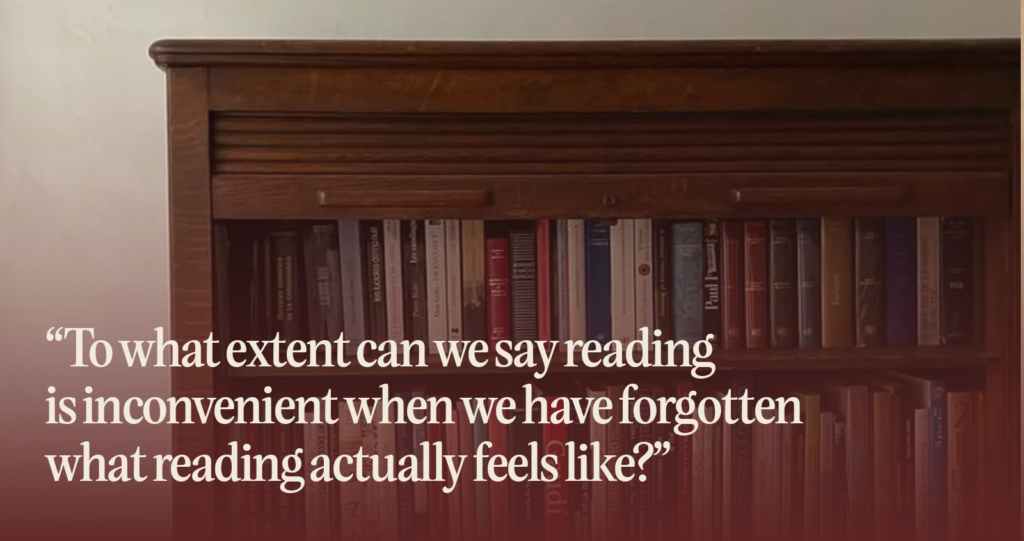
To what extent can we say reading is inconvenient when we have forgotten what reading actually feels like?
Perhaps the value of reading was never in how quickly we finish a book or how many books we can finish in the shortest amount of time, but in everything that happens while we’re reading. Making sure we’re all cozy underneath the covers before we start reading, that one line we cannot seem to understand unless we reread it at least five times, going back to a foreshadowing in a previous chapter after the plot twist already happened, or even the pauses we take to search for a word we don’t understand are all part of the experience. When we reduce the act of reading to something that simply needs to be completed rather than enjoyed, we lose sight of its purpose and abandon the act, leaving it to gather dust in the corner.
Just the mere actions of choosing which book to read and trying to find a quiet place to sit and relax, all before you immerse yourself in the story, take a significant amount of time. And once we get lost within each page we flip, time starts to fly to the point we lose track of it. This is what makes reading especially memorable — the journey it takes the reader.
Readers do not just read about the escapades the characters end up in, but experience the process and the time physical books offer as a sanctuary. It becomes more personal as they remember where and at what point in their life they were when they picked it up. The annotations on each page serve as a remembrance of what readers thought and felt during that moment, and how things changed as they continue to read.
We should be reminded of what physical reading feels like. Physical books demand our attention and give us a space where nothing else can interrupt us. No notifications at the top of the page, no messages appearing between paragraphs, and no “for you” page waiting for us when the events of the story die down.
Reading does not have to be efficient, and maybe that is precisely its value. A book is slow and that’s OK, because it forces us to stay on the page and anticipate the next action. Rereading a sentence or highlighting it because it resonated with us. Stopping at a chapter and returning to it days later. Spending an entire afternoon at a bookstore not knowing what we want, and leaving with a book we were never looking for in the first place.
Inconveniences, sure, but they are not obstacles. They are what make the reading experience memorable.
If reading is reduced to speed, then what is the point of reading at all? If slowing down means taking our time with each page and enjoying the feeling of how the book lays in our hands, how the texture of the book looks pleasing, and how we smile to ourselves as we annotate and write on the excerpts of each line, then perhaps the inconvenience is worth embracing.
We just have to remember how to read.